What is Pre-Cana? A Guide for Engaged Catholic Couples
If you’re preparing for a Catholic wedding, chances are you’ve heard the term Pre-Cana somewhere between your engagement and your first meeting with the parish priest. So what is Pre-Cana, exactly, and what does it actually involve?
This guide walks you through what Pre-Cana is, where the name comes from, what topics you’ll cover, how long it takes, and what happens during your sessions — so you know what to expect before you begin. Pre-Cana isn’t a checklist to survive. It’s a formation experience the Church built to help engaged Catholic couples prepare well for the Sacrament of Matrimony.
What Does “Pre-Cana” Mean?
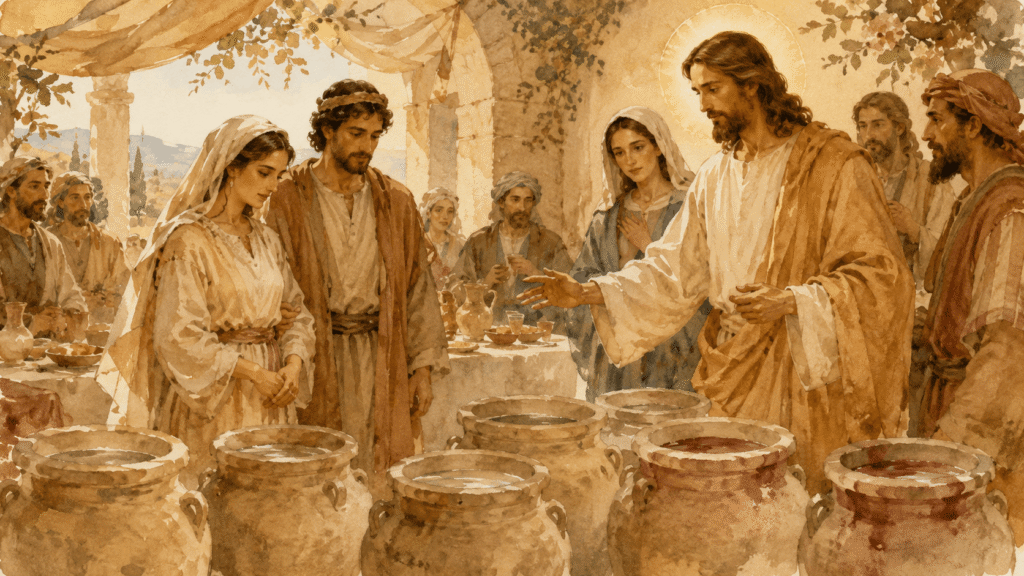
Pre-Cana literally means “before Cana.” The name comes from the wedding at Cana in Galilee, where Jesus performed his first public miracle — turning water into wine at a wedding feast (John 2:1-11).
On the third day there was a wedding at Cana in Galilee, and the mother of Jesus was there. Jesus also was invited to the wedding with his disciples.
— John 2:1-2
The Church has always read this scene as more than a convenient rescue for embarrassed hosts. Christ chose to reveal his divine glory for the first time at the celebration of a marriage. Ordinary water — everyday, human — became wine, rich and abundant. Marriage, for a Catholic couple, follows the same pattern: two people bring their humanity, and Christ makes something sacramental of it.
Pre-Cana is where the Church helps engaged couples prepare — spiritually, emotionally, practically — before they arrive at their own wedding day. The name has been used in U.S. dioceses since the 1940s, and today it covers everything from parish classroom courses to weekend retreats to self-paced online programs.
What Topics Does Pre-Cana Cover?
Pre-Cana programs vary in format, but nearly all cover the same eight core areas. Together they form the standard curriculum of Catholic marriage preparation in the United States.
- Communication. How you talk, listen, and handle disagreement — one of the strongest predictors of a durable marriage.
- Family finances. Budgeting, spending styles, debt, and merging two financial lives without merging two conflict styles.
- Intimacy and sexuality. Physical intimacy as a good and holy part of married life, in the context of the marriage covenant.
- Natural Family Planning (NFP). An overview of the Catholic-supported approach to family planning based on fertility awareness — Creighton, Marquette, Billings, Symptothermal.
- Conflict resolution. How to argue well: raising concerns without attacking, repairing after a fight, distinguishing surface issues from underlying ones.
- Family of origin. What each of you carries from the family you grew up in — patterns, wounds, unspoken rules — and what you want to keep or leave behind.
- Spirituality and prayer. Formation on the Sacrament of Matrimony itself, and how you’ll build a shared spiritual life together as a married couple.
- Roles and expectations. Assumptions about who does what, holidays, career priorities, how children will be raised — surfaced before they’re discovered.
Some programs add sessions on parenting, in-laws, or specific challenges facing modern couples. But these eight areas are the shared foundation across almost every Catholic Pre-Cana curriculum in the U.S.
How Long Does Pre-Cana Take?
How long Pre-Cana takes depends heavily on the format you choose.
- Traditional parish Pre-Cana — typically six to eight weekly sessions of one to two hours each, sometimes concentrated into a single Friday-evening-plus-Saturday weekend.
- Engaged Encounter weekends — a Friday-to-Sunday retreat format, about 20 hours of formation over three days.
- Online Pre-Cana courses — self-paced, typically completed in two to four weeks at a normal pace, or condensed into a long weekend if you want to move faster.
The actual time investment is similar across formats — roughly 15 to 20 hours of formation total. What differs is how that time is distributed and how much of it feels like homework versus in-person conversation.
Online vs In-Person Pre-Cana
There’s no single “right” Pre-Cana format. The best one for you depends on your schedule, your parish, and how you and your future spouse learn best together.
| Format | Duration | Typical cost | Best for |
|---|---|---|---|
| Parish Pre-Cana | 6-8 weekly sessions | $50–$200 | Couples embedded in a strong parish community |
| Engaged Encounter | Weekend retreat | $250–$400 | Couples who thrive on immersive experiences |
| Online Pre-Cana | 2-4 weeks self-paced | $99–$300 | Long-distance, non-standard schedules, privacy |
In-person parish Pre-Cana connects you to your parish community — you build relationships that continue after the wedding. The downside: you’re tied to a fixed schedule, and quality varies parish to parish.
Online Pre-Cana is the fastest-growing format, especially for couples separated by distance (long-distance engagements, military deployments, partners working in different cities before the wedding), couples with non-standard schedules (healthcare workers, first responders, shift workers), and couples who want privacy for the more intimate topics on the curriculum.
Some couples choose in-person sessions at their parish; others prefer the flexibility of an online format. Our own priest-led Pre-Cana course, for example, covers the same eight core areas in self-paced modules and is accepted by most dioceses across the United States.
Diocese acceptance is worth confirming with your parish priest before you commit. Most U.S. dioceses accept a wide range of programs — including reputable online courses — but a small number have specific in-house requirements. A quick email to your parish office resolves this in a day.
How Online Pre-Cana Actually Works
If you’ve never taken an online course before, it’s fair to wonder what “online Pre-Cana” actually looks like in practice. Programs vary from provider to provider, but most reputable ones share the same basic structure.
Content is delivered as a series of modules — usually one module per topic (communication, finances, intimacy, and so on). Each module blends video teaching, audio talks, written material, and structured reflection prompts. You work through the modules at your own pace, together as a couple, on whatever device is easiest — laptop, tablet, or phone.
Between the teaching portions, you’re given conversation prompts to talk through together. This is where the formation actually happens: the module introduces a topic; the prompts guide you into a conversation you might not have had otherwise. Some programs include an embedded premarital inventory (FOCCUS or PREPARE-ENRICH) that each of you completes separately, with the results reviewed together.
When you finish, the program issues a completion certificate as a PDF — usually sent by email — which you forward to your parish priest.
What to Expect During Your Pre-Cana Sessions
A Pre-Cana session — whether in a parish classroom or an online module — follows a predictable rhythm. Knowing the pattern ahead of time makes the experience less intimidating.
Most sessions begin with a teaching component — a priest, deacon, or trained presenter explains a specific topic (say, communication or Catholic teaching on sexuality). In an online format, this is delivered through video, audio, or written content.
After the teaching, couples are given time — often alone as a pair — to talk through what they just heard. Pre-Cana isn’t primarily about learning information. It’s about having conversations you might not otherwise have. The teaching provides the prompt; the conversation is where the formation happens.
Most programs use structured exercises — worksheets, journaling prompts, self-assessment tools — designed to surface assumptions and disagreements that might otherwise stay hidden until after the wedding.
In many parish formats, couples are paired with a sponsor couple — a married couple in the parish who walks alongside them through the program. In online formats, this role is often filled by the priest teaching the course.
The tone throughout is collaborative, not corrective. Pre-Cana is closer to “help you think about what you’re doing” than “check whether you’re ready.”
The Pre-Cana Certificate — What Your Parish Needs to See
At the end of Pre-Cana, your program issues a certificate of completion. This is the document your parish priest needs before the wedding — the tangible proof that you finished the required marriage preparation.
Most certificates include both partners’ names, the program name and provider, the dates of completion, and a signature or authorization from the program director. Your parish files it with the rest of your wedding paperwork (baptism certificates, dispensations if applicable, marriage license).
Diocese-specific requirements vary. Some dioceses ask that Pre-Cana be finished at least three months before the wedding date. Others accept only certificates from a specific list of approved programs. A small number require the priest officiating your wedding to sign off on the program before you begin.
If you complete Pre-Cana online, the certificate typically arrives as a PDF by email at the end of the course. You can print it and hand it to your priest at your next meeting, or simply forward the email directly.
Interested in an Online Pre-Cana Course? Meet Ours
Our online Pre-Cana Course is built by Rev. George Boronat for engaged Catholic couples who want their marriage preparation to be more than a checklist. It’s priest-led, self-paced, grounded in Catholic teaching from Humanae Vitae to the Theology of the Body — and accepted by most dioceses across the United States. Prepare well for your wedding with our faithful, flexible, priest-led course today.
Frequently Asked Questions
Pre-Cana means “before Cana.” The name comes from the wedding at Cana in Galilee (John 2:1-11), where Jesus performed his first public miracle by turning water into wine. It’s the Catholic Church’s marriage preparation program — the formation engaged couples complete before their wedding.
In most U.S. dioceses, yes. Canon 1063 of the Code of Canon Law requires parish communities to provide marriage preparation, and nearly every diocese in the United States has specific requirements. Ask your parish priest to confirm what your parish expects.
Anywhere from a single weekend retreat (about 20 hours) to eight weekly sessions spread over two months. Online Pre-Cana courses typically take two to four weeks at a normal pace. Most U.S. dioceses ask couples to give six months’ notice before the wedding.
Yes. Online Pre-Cana courses have become widely accepted across most U.S. dioceses over the past decade. They cover the same content as in-person programs and issue an equivalent certificate of completion. Confirm with your parish priest before enrolling.
Parish Pre-Cana usually costs $50–$200 per couple, sometimes free. Engaged Encounter weekends run $250–$400 including lodging. Online Pre-Cana courses typically cost $99–$300.
No. If one partner is Catholic and the other is not, both partners attend Pre-Cana together. Non-Catholic partners are not required to convert, but participation in the preparation program is expected — the topics apply to both of you.
Published by the Pre-Cana Course editorial team. Reviewed by Rev. George Boronat.